Saturday, 28 March 2009

The virtues of tea and the perils of hot drinks


Since the Dutch went to China (or possibly Japan) and discovered the medicinal drink of tea, it has come an awfully long way.

The British were introduced to it by the Dutch and Charles II's wife (who was actually Portuguese) made it popular. In 1664 the English East India Company brought the gift of tea to the British king and queen. In the same year the British took over New Amsterdam, named it New York, and the British tea tradition began.

Tea has been called the drink of Britain in spite of the fact that almost none is grown in the UK. (There is at least one small tea growing farm in Cornwall.) It has been the beverage that fuelled the growth of empire.

Tea has been in the news again recently, it appears that regular consumption of tea may boost your memory (BBC story here) and reduce the effects of Alzheimer's disease.

If the health benefits are what you are looking for then Green tea is the way to. If like me nothing gets you started in the morning like a cup of tea then it's the black leaf every time and this still has some protective effects on the brain.

Black tea or traditional English breakfast tea, is derived from the same plant as green tea, Camellia sinensis, but has a different taste and appearance because it is fermented.

Hot tea can kill!
But now there is shock news from Iran that drinking your tea too hot can increase the risk of throat cancer! It appears that if you regularly drink tea that is hotter than 70 degress C, it increases the risk of throat cancer. This thought to be because of the repeated damage to the cells in the throat from the heat of the liquid. In Iran, tea is typically drunk black i.e. with no milk. In Britain, most people add milk and this is enough to lower the temperature to around 60 degrees C.

More tea Vicar? Splash of milk? Lovely!

Thursday, 26 March 2009

Cheek chewing: a testimonial for hypnosis CD

A while back I created a hypnosis audio programme to deal with tongue and cheek chewing. It's an unusual topic area but I had come across a couple of clients with very similar needs and so created the program.

I recently sent out the CD to a lady who has been chewing the sides of her cheek for years and go the most amazing testimonial back; here is what she said.

I've been chewing my cheeks as long as I remember; I don't know why I started but I tend to chew when I'm stressed or bored, or on a long car journey. Most of the time I don't even realise I'm doing it till I draw blood, and then regret it and promise not to do it again ... till the next time.

I used one of the Gift4Life hypnotherapy CDs; this was one specially for people who chew their cheeks or tongue. I listened to the CD every night at bedtime for two weeks and to be honest I was a little bit cynical about it and didn't think it would help. However, over the course of that fortnight I noticed I was chewing my cheek less and less - and when I did do it I realised and stopped really quickly. By the end of the two weeks I'd almost stopped completely - I did catch myself doing it at a moment of great stress, so I listened to the CD again a few times and now I don't do it at all.

The CD itself was very relaxing, and quite unlike any other hypnosis CD I've heard in the past. John Burns' voice is very restful and as he invited me to visualised myself surrounded by colour I drifted away ... I can't actually remember much of what else was said, but whatever it was it obviously worked!

It's really changed my life - it might not sound like a big deal but when you chew your cheeks regularly it hurts, and you tend to leave rough bits of skin, which you then chew ... so it carries on. Having smooth, pain-free cheeks has really cheered me up and made me feel much better overall.

Alison Neale, Oxfordshire
That's hypnosis that works and it can work for you too.
You can download the program as an MP3 or buy the CD by going to my web site here.

The Jade Goody effect

Jade Goody rose to public fame after entering Channel 4's Big Brother house. She became famous (or perhaps that should be infamous) for outrageous behaviour whilst on that program and then later she took part in the Indian version of Big Brother.

She died on Mother's day, a more poignant date would be hard to imagine for this 27 year old mother. The final weeks and days of her life were lived out in a whirlwind of publicity that led towards the grim but inevitable conclusion of ever advancing cervical cancer.

As I sat in a garage cafe yesterday drinking a cup of coffee, I realised I was facing a rack of magazines and it seemed that each one featured a picture of Jade Goody on the cover. Something in her life has clearly moved many people to want to know more about her. The question is why?

By her own admission, Jade had little talent and yet lived her life through the lens of TV. What prompted people to watch and often ridicule her? And why, when her illness was diagnosed, did many people's view of her change from antagonism to sympathy?

Perhaps it is because it is so much easier for us to see what is wrong with another person's behaviour whilst being blind to our faults. We feel compelled to watch as things go wrong, just think about the 'rubbernecking effect' seen on motorways after a traffic accident. So when Jade was diagnosed with cervical cancer, some felt compelled to watch, it became a grim fascination with the impending death of another; a view into that last taboo.

Now we have a very real Jade Goody effect happening; the waiting time for a cervical smear in my local area is over a month. Women who have not had a smear test for years are now booking in to be tested. As women witnessed the heart rending path of Jade's life perhaps they came to realise that all of us are mortal no matter how famous or rich we may be.

A final thought; as Jade faced her own death head on and still shared her life with millions, somehow she became transformed from a loud mouthy TV personality to a brave mother doing anything it took to provide for her own children. Perhaps we can all be inspired by that transformation.

Wednesday, 25 March 2009

Changing capitalism=happiness?

There is much talk at the moment about changing capitalism to something that delivers results but has a more human face. 

President Sarkozy of France is promoting this 'New Capitalism' at the moment in the lead up to the G20 meeting.

If we believe that our actions are driven by our core beliefs, then perhaps it is these that could usefully be changed. Now that mainstream religion has become less important for many people, there is often no stock set of morals or beliefs to immediately align with. So like President Sarkozy, we are tempted to modify capitalism and maintain that as a belief system. I dub  this the "If I can just have one more handbag I'll be happy approach".

Sadly, I have found that in all the personal change work I have done with others, having one more handbag or one pair of shoes resulted in nothing more than a brief moment of satisfaction which is often followed by a sense of guilt or shame. Consumerism as a religion or core moral code does not work.

But as a society we have been in a similar position before. In the 19th century there were capitalists who both made money and had a core set of values that led them to use there business and money for the greater good.

One example of this was Joseph Rowntree, a chocolate maker and a Quaker (The Religious Society of Friends). Rowntree for example set up the first ever occupational pension scheme.  He built bought land to provide low cost housing and in 1905 set up charitable trusts that continue the work today (www.jrf.org.uk).

Could his example help us today? Not necessarily using his religion for guidance, but even anon religious  humanist could use their core inner beliefs and moral sense to guide them to a better way of working and living.

If capitalism's core belief is that any profit gained is good and that return on investment is the only true measure of worth, then we are probably doomed to repeat the boom/bust cycles every few decades. Greed will be the core belief at work and we already know that this on its own is destructive.

But just perhaps, if we and the people who invest on our behalf (pension funds for example) took a wider view than just monetary return on investment, we might have a better society for everyone.

Friday, 20 March 2009

Weight loss and hypnosis

Hypnosis and weight loss seem to go together like strawberries and cream. It is one of the key reasons why people go t a hypnotist or a hypnotherapist.

In my own practice it tends to be anxiety that clients call in for most often and the second most common issue is weight control.

It's not that clients don't know what is going on; they know that the habits they have are driving them further away from what they want to be.

Almost always there is an emotional driver that causes poor eating choices and habits, often coupled with a lack of any meaningful exercise. If we can deal effectively with the underlying emotional issue then the weight tends to fall away.

I came across this American hypnotist talking about weight loss on a news video; it's worth watching if you are considering taking this path. See the video here.

PS Yes you can call me on 01935 700333 to book sessions with me!

Wednesday, 18 March 2009

Cityboy; the book

I have just finished reading the book Cityboy. It is the fictionalised life of an Analyst working in the city of London finance district during the 1990s and up to the present day.(Actually to around 2004)

It is a great read but also very sobering. It exposes how the naked greed and aggression of traders can both manipulate the market and be manipulated by the potential for bonus payments that could many times annual salary.

If you want a clearer understanding of how human emotions and insecurity can drive a kind of collective madness I doubt you'll find a better book than this one.

Tuesday, 17 March 2009

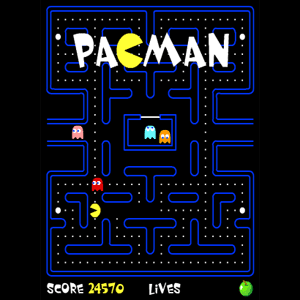
Pac Man, progress & power pills

There are times when each of us can blocked and unable to move on to "the next level".
Whether this relates to controlling our weight or dealing with personal debt, the barriers feel the same. On occasion they may be our lack of knowledge or more often they are our own fears that hold us back.

Steve Pavlina of the web site www.stevepavlina.com talks about this on a recent post he called "levelling up". He compares life to a series of levels in a Pac-Man video game; sometimes we get stuck on a particular level, unable to gobble up all the pellets (life lessons) and blocked in by ghosts (our fears).

So if we feel stuck, perhaps we still have things to learn about on our current level, maybe we have not yet absorbed the key lessons about being where we are. It's an interesting read and well worth spending some time on (it's quite a long post).

Very definitely food for thought, check it out by clicking here.

Monday, 16 March 2009

Alcohol, the drug of choice

There is much talk in the news today about the idea of raising the price of alcohol to a minimum of 50p per unit (around$0.70). That would make the average can of 5% beer (which contains 2.2units) cost £1.10 ($1.54), quite a bit more than it would be today for a mid range product.

The purpose of the increase is to reduce alcohol consumption, which has doubled since the 1960s (more information here) to around 11.5 litres per person, per year.

It might be useful to look at some of the changes that affected that increased consumption apart from the price. In my youth (I am a man in my mid 40s) there was very little in the way of Off-Licence (i.e. not being served in a bar) outlets. If you wanted to have a drink you either bought the booze from a shop during the day (remember that they closed at 5pm) or you went to the off sales counter in the pub.

Put simply, supply was much more restricted than it is today. Since a greater proportion of the sales went through pub, Landlords were more directly in control of who that alcohol was served to. This had the effect of controlling under-age drinking reasonably well.

The demand was always there, it was the supply that was restricted.

Today we have a vast supply capability, the demand is the same (or greater) as it ever was but the social controls have all but disappeared. Those pubs still in business are often much larger (the Wetherspoons mega pub model) and run by bar staff rather than a Landlord. So the control over who is buying and drinking is much reduced.

Virtually every small shop has an alcohol licence and they have a living to make. Can you remember how much media noise there was about garages selling wine and beer and how normal that is today? Youngsters will often persuade an adult stranger to buy booze on their behalf in exchange for cash or a can. The ability to control the supply has gone. All this without even beginning to consider the impact of the famed 24 drinking licence that was supposed to deliver cafe culture and instead started the Friday night ruck culture.

The Chief Medical Officer may be right, price may be the only way to reduce overall consumption but it will not stop the demand for drugs that make living in this society more tolerable than it is today. We seem to live in a world where each of us is pushed to deliver ever more and are coping with that less and less well. If it is not alcohol, it may tum out to be Prozac or weed instead.

Alcohol misuse is a societal problem that shows up as an individuals response to intolerable pressure. In the end there has to be a recognition that our society structures need to change to make life better. That sounds like a job for a clear thinking politician and they seem to be in very short supply.

Saturday, 14 March 2009

The unlikley perils of pusuing a personal growth plan

Friday, 13 March 2009

You can now follow me on Twitter


You can now follow me on twitter at http://twitter.com/johncburns.

I'm still not sure about how twitter works but this new form of microblogging seems to have many fans so I thought I'd join the twitters.