If you ever wanted to find out a little more about the process of hypnosis (especially as it relates to hypnotherapy) take a listen to this podcast.
It highlights the purpose behind the hypnotic induction and the result on the client's mind.
If you have any questions or feedback then please leave a comment. I'll be happy to answer your questions.
Wednesday, 8 January 2014


Tuesday, 7 January 2014
It's 2014; time to be kind to yourself - Podcast
It's all too easy to stumble into some New Year resolutions about changing your life but this year maybe try going about it in a different way.
Listen to the podcast below.
Have a great New Year!
Listen to the podcast below.
Have a great New Year!
Tuesday, 3 December 2013
I am not depressed but...
It's a number one hit, the NHS medical miracle, not just in the UK but all around the developed world.
Yes, it's the antidepressant pill.
The use of these drugs has risen to ever higher levels across the developed world since the SSRI (selective serotonin re-uptake inhibitors) compounds were first introduced in the early 1990s. A recent Guardian news paper story highlights the rising usage, http://www.theguardian.com/society/2013/nov/20/antidepressant-use-rise-world-oecd
Prozac (chemical name Fluoxetine) also known as Sarafem, Ladose and Fontex and it's sister chemical Citalopram have radically changed the medical world's response to depression treatment.
They are used to treat anxiety, blushing, panic and all manner of nervous disorders. For some the treatment works well for others the outcome can be worse than the condition. The list of side effects is long and rather troubling (see the Wikipedia page for more information http://en.wikipedia.org/wiki/Fluoxetine) and although there may be only a low percentage of user that have suicidal thoughts as a result of taking the tablets, some will act on those thoughts.
So ban them then?
The flip side of the coin is how many people would have taken their lives if they had not been taking anti-depressants? In fact according to the NHS higher usage of the treatment coincides with reducing suicide rates (http://www.nhs.uk/news/2013/07July/Pages/Prozac-nation-claim-as-antidepressant-use-soars.aspx)
So a ban seems unreasonable.
So are we really using them correctly? Are GPs just a bit too keen to pick up the prescription pad instead of looking at alternative approaches? Probably. However talking therapies (CBT, Counselling, even hypnotherapy) take time, skilled staff and....money. Drugs are relatively cheap, typically start working within 6 weeks and for most cause few side effects.
The problem is that they do not changes the patient's situation or thoughts patterns associated with the situation. It's a chemical fix for a life problem in many cases. It would appear that there are far more prescriptions issued than there are depressed people and so it seems we are trying to actually treat unhappiness in many cases.
Unhappiness is though, a completely natural condition, all of us will be unhappy at some point. It happens when we compare our situation as it is with the situation that we want or have a mental model of. That desired model may be unrealistic (talking therapy may help) or it may be realistic in different circumstances. (Can the patient change the circumstances?). But unhappiness is not depression and we should stop trying to treat it with drugs. As for life models not to follow, avoiding the celebrity news in the Daily Mail and elsewhere might be a good place to begin.
Yes, it's the antidepressant pill.
The use of these drugs has risen to ever higher levels across the developed world since the SSRI (selective serotonin re-uptake inhibitors) compounds were first introduced in the early 1990s. A recent Guardian news paper story highlights the rising usage, http://www.theguardian.com/society/2013/nov/20/antidepressant-use-rise-world-oecd
Prozac (chemical name Fluoxetine) also known as Sarafem, Ladose and Fontex and it's sister chemical Citalopram have radically changed the medical world's response to depression treatment.
They are used to treat anxiety, blushing, panic and all manner of nervous disorders. For some the treatment works well for others the outcome can be worse than the condition. The list of side effects is long and rather troubling (see the Wikipedia page for more information http://en.wikipedia.org/wiki/Fluoxetine) and although there may be only a low percentage of user that have suicidal thoughts as a result of taking the tablets, some will act on those thoughts.
So ban them then?
The flip side of the coin is how many people would have taken their lives if they had not been taking anti-depressants? In fact according to the NHS higher usage of the treatment coincides with reducing suicide rates (http://www.nhs.uk/news/2013/07July/Pages/Prozac-nation-claim-as-antidepressant-use-soars.aspx)
So a ban seems unreasonable.
So are we really using them correctly? Are GPs just a bit too keen to pick up the prescription pad instead of looking at alternative approaches? Probably. However talking therapies (CBT, Counselling, even hypnotherapy) take time, skilled staff and....money. Drugs are relatively cheap, typically start working within 6 weeks and for most cause few side effects.
The problem is that they do not changes the patient's situation or thoughts patterns associated with the situation. It's a chemical fix for a life problem in many cases. It would appear that there are far more prescriptions issued than there are depressed people and so it seems we are trying to actually treat unhappiness in many cases.
Unhappiness is though, a completely natural condition, all of us will be unhappy at some point. It happens when we compare our situation as it is with the situation that we want or have a mental model of. That desired model may be unrealistic (talking therapy may help) or it may be realistic in different circumstances. (Can the patient change the circumstances?). But unhappiness is not depression and we should stop trying to treat it with drugs. As for life models not to follow, avoiding the celebrity news in the Daily Mail and elsewhere might be a good place to begin.
Monday, 30 September 2013
Drain or radiator; which are you? - Podcast
We all know people who can drain the positive energy in a room simply by being there. Probably you also know some people who can lift the most despondent situation.
It's useful to think of these different people as drains (on your emotions) or radiators (of positive energy). But is that the whole story? This 6 minute podcast explores the idea further.
It's useful to think of these different people as drains (on your emotions) or radiators (of positive energy). But is that the whole story? This 6 minute podcast explores the idea further.
Sunday, 8 September 2013
Edgar Cayce - what an intriguing life
Edgar Cayce was born in the 19th century and lived through the first half of the 20th.
He is often seen as a seer or prophet. He used a self hypnosis technique to access a source of information (sprirt or other-worldly) that provided information on treatments for medical conditions.
Deeply grounded in a Christian faith his ability to give 'readings' often gave him doubts about how he should use this 'gift'.
Whilst giving his readings in what seemed to be a self-hypnotic state, he was unaware of the information he provided.
He story in written the book Story of Edgar Cayce: There is a river by Thomas Sugrue. http://www.amazon.com/Story-Edgar-Cayce-There-River/dp/0876043759
I am part way through reading the book and find myself absolutely intrigued by the story and the messages in it.
Well worth a look for the enquiring mind.
He is often seen as a seer or prophet. He used a self hypnosis technique to access a source of information (sprirt or other-worldly) that provided information on treatments for medical conditions.
Deeply grounded in a Christian faith his ability to give 'readings' often gave him doubts about how he should use this 'gift'.
Whilst giving his readings in what seemed to be a self-hypnotic state, he was unaware of the information he provided.
He story in written the book Story of Edgar Cayce: There is a river by Thomas Sugrue. http://www.amazon.com/Story-Edgar-Cayce-There-River/dp/0876043759
I am part way through reading the book and find myself absolutely intrigued by the story and the messages in it.
Well worth a look for the enquiring mind.
Wednesday, 28 August 2013
What can time and dedication achieve? A great deal
I saw this report in the Daily Mail newspaper and it reminded me that in this age of the pre-packed, pre-prepared almost everything, you can build extraordinary things from scratch.
http://www.dailymail.co.uk/news/article-2402990/Former-monk-Justo-Gallego-Martinez-spends-50-YEARS-creating-giant-cathedral-junk.html
A cathedral built from junk and discarded building materials, by just one former monk, without a crane over the course of 50 years.
 Of course as construction has taken so long, Juston Gallego Martinez may never see his church completed but when asked about the building by the BBC he said
It makes me wonder about what anyone can achieve give simple time, effort and dedication.
 |
| The part finished cathedral 12 miles outside of Madrid |
http://www.dailymail.co.uk/news/article-2402990/Former-monk-Justo-Gallego-Martinez-spends-50-YEARS-creating-giant-cathedral-junk.html
A cathedral built from junk and discarded building materials, by just one former monk, without a crane over the course of 50 years.

'If I lived my life again, I'd build this cathedral again only bigger.
'Twice the size, because for me, this is an act of faith.'
 |
| The former Trappist monk who started construction of the cathedral after surviving TB |
Saturday, 17 August 2013
On the nature of death
It sounds like a morbid title for a blog post doesn't it?
I've been thinking about death, not the dying bit or even what comes after death (if anything). No, more on what impact our individual lives have on the world. What do we leave behind? Which people did we touch in some way? What mark did we leave on the universe?
All this pondering started with the death of Frank. Frank was not a relative, he was an older man who lived across the road from me. How old was he? Perhaps in his middle eighties, I have lived in the same house for more than 10 years now and he seemed elderly even when I moved in.
We passed the time of day, said hello and good morning, even sent each other Christmas cards but truthfully I didn't know much about him.
Recently an ambulance arrived near our house, it's not often a good sign having the yellowy green wagon parked up. This time it was for Frank. His final journey whilst in this world.
So it fell to his family to clear his home and deal with his estate. There followed a succession of skips placed on his driveway. The contents of his life were piled into them. One affected me more than the others, it had a child's plastic jeep toy perched on the top. I imagine it had been kept back as a toy for the grandchildren to play with. It was a bit like this one in the picture.
And that's when I almost cried. Is that all a man's life is? I asked myself. A collection of skips and 20 black plastic bags of rubbish to be cleared from a home?
Of course not; but it was a deeply sobering moment. What mark do we leave on the universe when our physical self is gone? If we have children then in a sense we have a mark that continues into the future but what else? For those of us who do not write great literature or create wonderful works of art, what do we leave? Are we no more than a few builders skips of stuff and 20 black plastic bin bags?
In a way this is our search for significance, our ego wanting to have its way. But still each of us searches for that significance.
Then I spoke with a friend who had similar discussions and had been told about a book called 'The five people you meet in heaven'. It's on Amazon here
http://www.amazon.com/The-Five-People-Meet-Heaven/dp/1401391346
I have yet to read it, but it's a parable about the impacts and effects we have on people as we travel through life, effects that we may be barely aware of.
Perhaps your smile one morning helped someone to keep going instead of taking an overdose. Perhaps as you let a car out form a side road you prevented an accident that would have maimed another. Perhaps our search for significance is that accumulation of simple good deeds that helped others be better than they would have been.
What mark will you be leaving on the universe?
I've been thinking about death, not the dying bit or even what comes after death (if anything). No, more on what impact our individual lives have on the world. What do we leave behind? Which people did we touch in some way? What mark did we leave on the universe?
All this pondering started with the death of Frank. Frank was not a relative, he was an older man who lived across the road from me. How old was he? Perhaps in his middle eighties, I have lived in the same house for more than 10 years now and he seemed elderly even when I moved in.
We passed the time of day, said hello and good morning, even sent each other Christmas cards but truthfully I didn't know much about him.
Recently an ambulance arrived near our house, it's not often a good sign having the yellowy green wagon parked up. This time it was for Frank. His final journey whilst in this world.
So it fell to his family to clear his home and deal with his estate. There followed a succession of skips placed on his driveway. The contents of his life were piled into them. One affected me more than the others, it had a child's plastic jeep toy perched on the top. I imagine it had been kept back as a toy for the grandchildren to play with. It was a bit like this one in the picture.
 |
| Is this what we are left with? |
And that's when I almost cried. Is that all a man's life is? I asked myself. A collection of skips and 20 black plastic bags of rubbish to be cleared from a home?
Of course not; but it was a deeply sobering moment. What mark do we leave on the universe when our physical self is gone? If we have children then in a sense we have a mark that continues into the future but what else? For those of us who do not write great literature or create wonderful works of art, what do we leave? Are we no more than a few builders skips of stuff and 20 black plastic bin bags?
In a way this is our search for significance, our ego wanting to have its way. But still each of us searches for that significance.
Then I spoke with a friend who had similar discussions and had been told about a book called 'The five people you meet in heaven'. It's on Amazon here
http://www.amazon.com/The-Five-People-Meet-Heaven/dp/1401391346
I have yet to read it, but it's a parable about the impacts and effects we have on people as we travel through life, effects that we may be barely aware of.
Perhaps your smile one morning helped someone to keep going instead of taking an overdose. Perhaps as you let a car out form a side road you prevented an accident that would have maimed another. Perhaps our search for significance is that accumulation of simple good deeds that helped others be better than they would have been.
What mark will you be leaving on the universe?
Monday, 22 July 2013
Did you watch the TV program about Uri Geller?
In the UK yesterday, the BBC screened a program about Uri Geller.
For people in the UK who remember the early 1970's, Uri Geller was a sensation. He bent spoons using telekinesis, he restarted broken watches (from a distance) and used remote viewing skills to 'see' the picture drawn by another person in a sealed envelope. At least he did if you took these things at face value. There are plenty of skeptics out there say he is nothing more than a savvy showman. Those skeptics include James Randi (http://www.randi.org/site/) who specialises in debunking paranormal events.
So I watched the program as an interested skeptic. I could recall his appearances on TV in my childhood and the number of people in the UK who tried to bend spoons with the power of the mind. It was quite an event whenever Geller was on TV.
I settled down to watch the program (http://www.bbc.co.uk/programmes/b037k0c5) and discovered lots that I had not known about the man; for example about his being a paratrooper in the Israeli 6Day War in 1967, nor that he now lived in the UK.
Nor was I aware of his work with US Government agencies in the realm of remote viewing. He certainly seems to have convinced some scientists and researchers that he had some unusual abilities. (see more detail here https://en.wikipedia.org/wiki/Uri_Geller) Geller himself chose on several occasions during the program to self censor saying he could not talk about that event or situation.
So is he a fraudster or a man gifted with telekinesis? A trickster or a man with most unusual powers? I'm not sure, it was certainly intriguing and worth a hour of your time to watch the program. (The BBC link may not work if you are outside the UK)
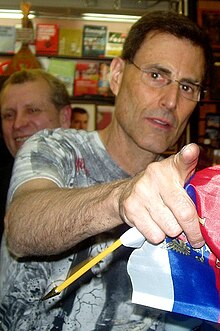 |
| Uri Geller (Wikipedia picture) |
For people in the UK who remember the early 1970's, Uri Geller was a sensation. He bent spoons using telekinesis, he restarted broken watches (from a distance) and used remote viewing skills to 'see' the picture drawn by another person in a sealed envelope. At least he did if you took these things at face value. There are plenty of skeptics out there say he is nothing more than a savvy showman. Those skeptics include James Randi (http://www.randi.org/site/) who specialises in debunking paranormal events.
So I watched the program as an interested skeptic. I could recall his appearances on TV in my childhood and the number of people in the UK who tried to bend spoons with the power of the mind. It was quite an event whenever Geller was on TV.
I settled down to watch the program (http://www.bbc.co.uk/programmes/b037k0c5) and discovered lots that I had not known about the man; for example about his being a paratrooper in the Israeli 6Day War in 1967, nor that he now lived in the UK.
Nor was I aware of his work with US Government agencies in the realm of remote viewing. He certainly seems to have convinced some scientists and researchers that he had some unusual abilities. (see more detail here https://en.wikipedia.org/wiki/Uri_Geller) Geller himself chose on several occasions during the program to self censor saying he could not talk about that event or situation.
So is he a fraudster or a man gifted with telekinesis? A trickster or a man with most unusual powers? I'm not sure, it was certainly intriguing and worth a hour of your time to watch the program. (The BBC link may not work if you are outside the UK)
Tuesday, 9 July 2013
Does hot weather = a short temper?
Warm weather is generally welcomed by most people, it seems to lift the mood and bring a feeling of well being to all.
But hot weather? That may be different. There have been attempts to make the direct connection between the temperature and increased crime levels but the correlation is not always clear.
Some articles that consider this point:
http://weakonomics.com/2009/07/30/why-crime-is-higher-when-its-hot-why-economics-fails-us/
and
http://www.wired.com/wiredscience/2011/07/hot-weather-violence/
However I think there is enough evidence to suggest that when very hot our tolerance to annoying outside factors is reduced compared to when we are at more usual temperatures. It may not be that you are annoyed but perhaps just feel a little uncomfortable.
So what can you do if you don't have an air conditioned car or building to slip into and cool off?
Use the power of your imagination. Imagine you are some where cooler, perhaps recall a time when you walked through the chilled goods section of the supermarket. Allow yourself to fully engage in the imagination of the moment to quote Paul McKenna "See what you saw, hear what you heard, feel what you felt".
Your mind and the autonomic nervous system will do the rest so that for a long as you stay in that imaginery cool spot, things will feel a little more comfortable.
Alternatively, take a deep breathe in, breathe out slow and then sip the chilled drink of your choice in a shady spot.
But hot weather? That may be different. There have been attempts to make the direct connection between the temperature and increased crime levels but the correlation is not always clear.
Some articles that consider this point:
http://weakonomics.com/2009/07/30/why-crime-is-higher-when-its-hot-why-economics-fails-us/
and
http://www.wired.com/wiredscience/2011/07/hot-weather-violence/
But even as the true nature of links between violence and hot weather remain uncertain, one 1976 study stands out in its simplicity and practicality: Angry people can be soothed with a cold drink.
However I think there is enough evidence to suggest that when very hot our tolerance to annoying outside factors is reduced compared to when we are at more usual temperatures. It may not be that you are annoyed but perhaps just feel a little uncomfortable.
So what can you do if you don't have an air conditioned car or building to slip into and cool off?
Use the power of your imagination. Imagine you are some where cooler, perhaps recall a time when you walked through the chilled goods section of the supermarket. Allow yourself to fully engage in the imagination of the moment to quote Paul McKenna "See what you saw, hear what you heard, feel what you felt".
Your mind and the autonomic nervous system will do the rest so that for a long as you stay in that imaginery cool spot, things will feel a little more comfortable.
Alternatively, take a deep breathe in, breathe out slow and then sip the chilled drink of your choice in a shady spot.
Wednesday, 3 July 2013
3 simple (free) ways to reduce anxiety
I see many clients who have anxiety, it is a very common condition in our society today.
If you see your GP about this it's likely that they will prescribe some form of anti-depressant or beta blocker. If you are fortunate perhaps you will be offered some form of counselling.
Some what simple steps can you take to reduce anxiety?
1) It is far more useful to consider that you are 'doing anxiety' rather than feeling anxious. It's a simple but important distinction as it opens up the possibility of change. If you are 'doing anxiety' right now perhaps you can do calmness later.
2) Cut out sources of caffeine; tea coffee, coke, Red Bull etc. If you are feeling anxious the last thing you need is extra stimulation.
3) Make sure you have as well a balanced diet as you can. Fresh fruit and vegetables provide you with B vitamins and magnesium that tend to reduce anxiety.
One extra; drink plenty of water. Being even a little dehydrated will raise your anxiety.
If you see your GP about this it's likely that they will prescribe some form of anti-depressant or beta blocker. If you are fortunate perhaps you will be offered some form of counselling.
Some what simple steps can you take to reduce anxiety?
1) It is far more useful to consider that you are 'doing anxiety' rather than feeling anxious. It's a simple but important distinction as it opens up the possibility of change. If you are 'doing anxiety' right now perhaps you can do calmness later.
2) Cut out sources of caffeine; tea coffee, coke, Red Bull etc. If you are feeling anxious the last thing you need is extra stimulation.
3) Make sure you have as well a balanced diet as you can. Fresh fruit and vegetables provide you with B vitamins and magnesium that tend to reduce anxiety.
One extra; drink plenty of water. Being even a little dehydrated will raise your anxiety.
Subscribe to:
Posts (Atom)

 Posts
Posts